
- The R36S verdict at a glance
- R36S specs
- Design and handling
- The screen: 3.5 inches, 640 x 480, IPS
- Performance by system
- 8-bit and 16-bit consoles
- PlayStation 1
- Nintendo 64
- PSP
- Dreamcast
- Battery: 3000 or 3200 mAh, runtime not measured
- Firmware: ArkOS and the alternatives
- What the R36S doesn't have
- Price: why it's $25 to $50 elsewhere and $79.99 here
- Who should buy the R36S, and who should pick an R36 Max or R36 Ultra
- R36S review FAQ
- Is the R36S worth it?
- Is the R36S good for PSP?
- How long does the R36S battery last?
- Does the R36S have Wi-Fi?
- R36S vs Miyoo Mini Plus: which is better?
- Bottom line
- Find your R36S Console
Short answer
The R36S is a strong pick if you mainly play 8-bit, 16-bit and PlayStation 1 games: its quad-core RK3326 chip, 3.5-inch 640 x 480 IPS screen and two analog sticks are well matched to that era. N64 and PSP work game by game. There is no Wi-Fi, no Bluetooth and no TV output.
The R36S verdict at a glance
- Best for: 8-bit, 16-bit and PS1 libraries in a 187 g vertical body you can pocket.
- Workable: part of the N64 and PSP catalogs. Check the titles you care about before you buy.
- Not for: anyone who needs Wi-Fi, Bluetooth, a TV connection or stereo speakers.
- Price: typically $25 to $50 on marketplaces, $79.99 here with a 64 GB card, duties included and 30-day returns. We explain the gap below.
Mostly 8-bit to PS1? The R36S from our supplier's “Dual Chip Original” line, $79.99 with a 64 GB card, free shipping.
R36S specs
Source: Handhelds wiki R36S page, last edited May 2025.
| Component | R36S |
|---|---|
| Released | October 2023 |
| Form factor | Vertical |
| Chip (SoC) | Rockchip RK3326: quad-core Cortex-A35 CPU, Mali-G31 MP2 GPU |
| RAM | 1 GB DDR3L, split across two chips on the board |
| Screen | 3.5-inch IPS, 640 x 480, 4:3 |
| Storage | No internal storage, two microSD slots (our units ship with a 64 GB or 128 GB card) |
| Wi-Fi / Bluetooth | No / No |
| Video output | None |
| Audio | Mono speaker, 3.5 mm headphone jack |
| Battery | 3000 or 3200 mAh, depending on the production lot |
| Size and weight | 13 x 8.3 x 3.5 cm (about 5.1 x 3.3 x 1.4 in), 187 g (about 6.6 oz) |
| Software | Linux, with community firmware such as ArkOS, AmberELEC and ROCKNIX |
Source: the Handhelds wiki R36S page (last edited May 2025) and our product listing for the card sizes.
Not confirmed
You will often see a 1.5 GHz clock speed quoted. We have not found a maker spec sheet that confirms it, so it stays out of the table.
The "two chips" detail on the RAM line is the one to remember. The wiki's R36S clones page notes that the clones it documents carry a single RAM chip instead of two. Our original vs clone guide shows how to check yours.
Design and handling
The R36S is a vertical handheld: screen on top, controls below. It measures 13 x 8.3 x 3.5 cm and weighs 187 g, so it fits a jacket pocket and stays light in the hand.
The controls are the main reason to pick it over the cheapest handhelds. You get a D-pad, face buttons, shoulder buttons and two analog sticks. Stick-less devices such as the Miyoo Mini Plus can't offer that, and it matters for 3D games designed around analog control.


We won't put a number on comfort, because hand size varies too much. A practical test: hold a phone you own and picture a 13 x 8.3 cm footprint. That comparison tells you more than any adjective we could use.
Underneath, two microSD slots split the job. One card boots the system, the second can hold your game library. The wiki even lists a clone variant that lacks the second games slot, one more thing worth checking on arrival.
The screen: 3.5 inches, 640 x 480, IPS
The panel is a 3.5-inch IPS screen at 640 x 480. That resolution is low next to a phone, but the games you'll play were drawn for TVs of a similar or lower resolution.
The 4:3 shape is the quiet advantage. Most home consoles of the 8-bit to PS1 era output a 4:3 picture, so their games fill the R36S screen edge to edge without black bars.
That changes on some siblings. The R36 Max and the 4-inch R36 Ultra use a square 720 x 720 screen, so 4:3 games leave bars on the sides. The R36 Ultra X goes back to 4:3 with a 4.5-inch 1024 x 768 panel.
Performance by system
Every genuine R36S runs the same RK3326 chip with 1 GB of RAM. It is a low-power chip, so the further you move into 3D-heavy consoles, the more results depend on the specific game, the emulator and your settings.
We have not benchmarked titles one by one, so the tiers below are deliberately cautious. Our R36S game list guide goes system by system if you want titles.
8-bit and 16-bit consoles
NES, SNES, Genesis, Game Boy and Game Boy Advance are the core of what this device is for. These systems ask little of the RK3326, and the home consoles among them match the 4:3 screen.
PlayStation 1
PS1 is where the R36S stays comfortable across most of the library, and it's the best reason to buy one. The two analog sticks help with games that were built for a dual-analog controller.
Nintendo 64
N64 is game by game. Lighter titles are the better bet, while demanding ones can slow down or need settings changes. If a single N64 game is your reason to buy, look for footage of that exact title running on an RK3326 device first.
PSP
PSP sits near the ceiling of what this chip can attempt. Some lighter and 2D titles are the realistic target. Treat demanding 3D PSP games as a maybe, not a promise.
Dreamcast
Don't buy an R36S for Dreamcast. Count anything that runs well as a bonus rather than a feature.
Same chip across the family
One point that changes buying decisions: the R36 Max and R36 Ultra use the same RK3326 and 1 GB of RAM. A bigger screen or Wi-Fi does not move a game from "slow" to "smooth". If N64 or PSP is your priority, a different chip is the real upgrade, not a different R36.
Battery: 3000 or 3200 mAh, runtime not measured
The R36S battery is rated 3000 or 3200 mAh depending on the production lot. Both figures circulate because both exist.
Not measured
We have not measured runtime, so we won't print one. Some listings advertise "up to 6 hours", but that figure comes from a seller page, not from a test we can point you to.
What you can count on is the direction. A brighter screen, higher volume and heavier systems all shorten a session. A 16-bit game at moderate brightness will last longer than a PS1 game at full brightness.
Charging is over USB-C, and the cable is in the box. If battery size is your priority, the R36 Max and the R36 Ultra X are listed at 4000 mAh by their makers, again without a runtime we have verified.
Firmware: ArkOS and the alternatives
The R36S runs Linux, and that is a big part of its appeal. The wiki lists several community firmwares for it, including ArkOS, AmberELEC, ROCKNIX, Lakka and EmuELEC.
ArkOS is the usual starting point. With ArkOS on a genuine unit, the boot screen shows an "ArkOS 2.0" message with a date. Our R36S firmware and custom OS guide compares the options, and the R36S update guide walks through updating.
The wiki documents one trap. Some clones can't run standard ArkOS or AmberELEC at all: you get a black screen and a blinking red LED. Those boards use different device files (dtb) and need firmware made for clones.
Before you flash
Before you flash anything, back up the card that came with the console. Since the R36S has no internal storage, that card is the whole system.
What the R36S doesn't have
Limits to accept
- No Wi-Fi: no online features. Games and updates go onto the microSD card from a computer, as our guide to loading games explains.
- No Bluetooth: no wireless headphones or controllers. Use the 3.5 mm jack for audio.
- No video output: it's handheld only. You can't connect it to a TV.
- Mono speaker: a single speaker. For better sound, plug headphones into the 3.5 mm jack.
- No internal storage: if the system card fails, the console won't boot until you write a new one.
- No confirmed game count: our cards come with preloaded retro games, but we don't publish a number we haven't verified.
Price: why it's $25 to $50 elsewhere and $79.99 here
Google's summary of R36S reviews puts the typical price at $25 to $50. The Handhelds wiki listed 25 to 35 euros in May 2025. Ours is $79.99 with a 64 GB card, or $89.99 with 128 GB. Here is where the difference goes.
What the extra money covers when you buy from us:
What the price covers
- The board: we stock the unit our supplier's catalog lists as "R36S Dual Chip Original", the two-RAM-chip version, priced above the basic R36S in that same catalog. You can verify it on arrival with our clone guide.
- The card: a 64 GB microSD card is included, or 128 GB for $89.99.
- Shipping: free and tracked. Orders ship within 24 to 72 business hours, then delivery takes 5 to 10 business days.
- Duties: taxes and customs duties are included, so nothing is due on delivery.
- Returns and warranty: 30-day returns and a 30-day warranty. Return shipping is on you unless the unit is defective, wrong or not as described.
- A contact: contact@r36s-console.com, run by ANIMOUF LLC, a Wyoming company.
When we're not the right buy: if budget comes first and you're comfortable checking the board yourself, reflashing a card and handling a marketplace return, a cheaper listing can make sense. Use the clone checklist the day it arrives.
Who should buy the R36S, and who should pick an R36 Max or R36 Ultra
All four models below share the RK3326 chip and 1 GB of RAM, so they run the same games. The real differences are the screen, the battery and Wi-Fi.
| Model | Screen | Battery | Wi-Fi | Our price | Pick it if | Skip it if |
|---|---|---|---|---|---|---|
| R36S | 3.5-inch, 640 x 480, 4:3 | 3000 or 3200 mAh | No | $79.99 (64 GB) | you want the classic, with 4:3 games full screen | you need Wi-Fi or a bigger screen |
| R36 Max | 4-inch, 720 x 720, 1:1 | 4000 mAh (maker) | No | from about $87 | you want a bigger screen and battery | black bars on 4:3 games would bother you |
| R36 Ultra | 4-inch, 720 x 720, 1:1 | 3000 mAh per our listing, 3500 per retrohandhelds.gg | Yes, 2.4 GHz | from about $92 | Wi-Fi matters to you | you want the most screen for the money |
| R36 Ultra X | 4.5-inch, 1024 x 768, 4:3 | 4000 mAh (maker) | Yes | from about $104 | you want the largest 4:3 screen in the family | pocket size and price come first |
Converted prices for the Max and Ultra models can move with the exchange rate: check the R36 Max and R36 Ultra pages for the current price.
Buy the R36S if you want the smallest model and your library is mostly 8-bit, 16-bit and PS1. Skip the whole family if PSP or Dreamcast is the main goal: none of these models changes the chip.
For a balanced outside view, the reviewer at retrohandhelds.gg called the R36 Ultra "another solid RK3326" device and concluded it doesn't do enough to stand out. Our R36S vs R36 Max vs R36 Ultra comparison and R36 Ultra vs R36S page go further.
R36S review FAQ
Is the R36S worth it?
Yes, if your library is mostly 8-bit, 16-bit and PS1 games and you don't need Wi-Fi or a TV connection. It runs a quad-core RK3326 with 1 GB of RAM and has two analog sticks. If PSP or Dreamcast is the main reason you're buying, no R36 model changes much, because the Max and Ultra use the same chip.
Is the R36S good for PSP?
Only partly. The RK3326 is a low-power chip and PSP sits near the top of what it can attempt, so results vary from one game to the next. Lighter and 2D titles are the better bet, while demanding 3D games may run slowly. Check the titles you care about in our game list guide, and don't expect the R36 Max or Ultra to do better.
How long does the R36S battery last?
We haven't measured it, so we won't give you a number dressed up as a test. The battery is 3000 or 3200 mAh depending on the production lot. Some listings advertise up to 6 hours, but that is a seller claim. Screen brightness, volume and the system you emulate all change how long a charge lasts.
Does the R36S have Wi-Fi?
No. The R36S has no Wi-Fi and no Bluetooth, so there are no online features and no wireless headphones. Audio goes through the mono speaker or the 3.5 mm jack, and games go onto the microSD card from a computer. If you want Wi-Fi in the same family, the R36 Ultra and Ultra X have 2.4 GHz Wi-Fi.
R36S vs Miyoo Mini Plus: which is better?
Both use a 3.5-inch 640 x 480 IPS screen. The R36S adds two analog sticks and a quad-core RK3326, which gives it more room for 3D systems such as PS1 and part of the N64 library. The Miyoo Mini Plus is smaller (108 x 78.5 x 22.3 mm, about 165 g), has no sticks and runs Onion OS. Our R36S vs Miyoo Mini Plus comparison has the details.
Bottom line
The R36S does one job well: 8-bit to PS1 games on a 4:3 screen, with two sticks, in a 187 g body. It asks you to accept no Wi-Fi, a mono speaker and a game-by-game experience on N64 and PSP.
If that trade suits you, the original R36S console is where we'd start. If it doesn't, the comparison table above tells you which sibling fits, or whether you need a different chip altogether.
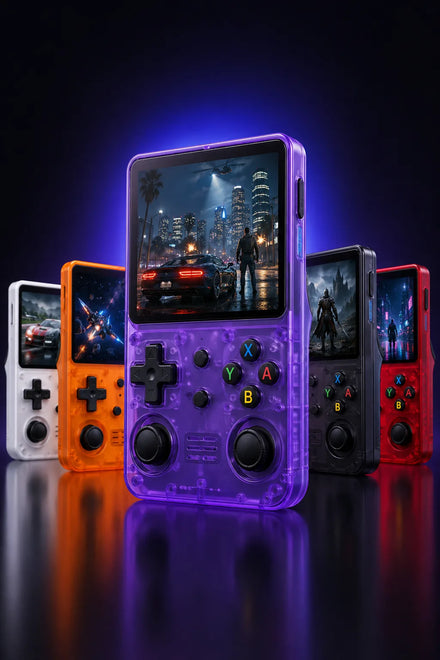
Find your R36S Console
Explore the 3.5-inch IPS handheld, compare 64GB and 128GB options, and check delivery information for your destination.
